Social AI Expedition coffee 3 · The Hague
A conversation a week after a successful two-day session. What if the technology is good enough?
Joost and Lars were in The Hague. A week earlier they had run a two-day session with a management team together, a successful session in which AI ran along in this form. Lars was the facilitator in the room, Joost sat at a distance, listening in and building. Today was the first quiet hour in which they could look back on it. Fresh reflections, then, and alongside the evaluation a second layer rose to the surface: what shifts when the technology becomes good enough, and which role you still want to play yourself.
"It costs me far more energy to talk about the packaging than about the content."
Joost checks in with something that's starting to simmer: a search for a place to land. He has been busy with Social AI a lot, just not so much with the content itself. He notices he's losing energy to something else: making what he does translatable for people who don't build it themselves.
He enjoys the content. There's curiosity in it, inventing things, laying lenses over transcripts, discovering what happens when you write a prompt differently. But the packaging, the explaining, the positioning, the making sure others understand why it matters, costs him a disproportionate amount. "Packaging turns out to be very important."
Lars immediately hears an invitation question underneath it. The packaging, he says, determines whether people go into the content or start doing it. The packaging isn't just a form. It's an invitation, or the opposite of one.
Where does the attention go?
The packaging isn't decoration on top of the content. It's what gives others access. But it's also the place where you can watch your own energy drain away, and have to decide whether that's okay for what comes back in return.
"How do you explain thoughtfulness to a machine?"
Joost explains that by now there are two documents he keeps handing to the AIs he works with. One is called, for the moment, the principles of Social AI for AI. It sets out what thoughtfulness means when you're a Large Language Model. Going through your work twice instead of once. Distinguishing between what you know and what you suspect. The other document is about prompting best practices: how you translate the whole workshop approach into an instruction a model can follow.
Lars recognizes the kind of writing. As a student he wrote ISO descriptions for cleaning laboratory equipment. Step by step, so precise that the next student could do it without explanation. "Very nuanced, very detailed, and as little open to two interpretations as possible." For dummies, so the person carrying it out can't come up with anything other than what you mean.
Joost responds straight away: yes, that's exactly it. You steer the thing very precisely, I want you to do this and not that. And at the same time: at certain points you actually want to say "think in this direction, and if something else comes up, show it", so there's room left for the model's intelligence. "How do you steer without locking it down completely, because then sometimes you get exactly the results you don't want."
And that's only the first layer. With prompts you often have to actively name what you want to see happen. "Don't think of a pink elephant" backfires: everyone immediately thinks of a pink elephant. LLMs too. What you don't ask for often doesn't happen. What you do ask for has to be worded extremely well. And sometimes you discover along the way that you've locked something down too rigidly, and then the work becomes: how do you open it back up? The art is in that back-and-forth.
The manual for a cleaner, and the prompt for a thinker
Two kinds of precision that work woven into each other. The manual precision steers very specifically: this yes, that no. The prompt precision does that too, only you often have to name something actively to get it, and you discover along the way whether you've actually locked it down too rigidly. Writing thoughtfulness for a machine means choosing what should be closed and what may be left open, often within the same document, and looking again each time.
"Just like I don't ask permission to use Appreciative Inquiry."
The evaluation of the two-day session starts with a question Joost had for next time. How do you package AI in a session so people pick it up without it being about the tool? Lars answers not from the technology, but from his own craft.
He never asks permission to use Appreciative Inquiry. He doesn't say: "Would you all be okay with me using a method today where we first look at what's already going well?" He uses it. He gets to know everyone, asks appreciative questions, lets the atmosphere take shape, and when people then say "what a lovely conversation", he proposes carrying that conversation on. He lays it in, instead of imposing it. But he does lay it in very deliberately.
For AI it works the same way, he discovers during the two-day session. Not announcing the tool as "we're going to try something new, is that okay with you all". Rather: here's a QR code, you scan it, I'll come by if you ask what you should do. First demonstrate, then it becomes obvious, then movement. What does belong with it is thoughtfulness around the fact that it's something new. It's a working method that records voices. That deserves an explanation. But not a request for consent, because you arranged that beforehand in the interviews.
How do you introduce a working method?
The middle position looks democratic but takes your craft knowledge out of the room. The third position holds on to the expertise (this is how I do this, that's my craft) while the room to join in stays open. For AI in a session the same holds as for any other working method.
"Who records?"
In a breakout group someone gets stuck because there's a half-hour gap in the recording. Nobody had realized that her phone was the only recording. What Lars sees emerging isn't a technical problem but a social pattern. The group is, without noticing, sorting out a new role among themselves.
In every working group you know the standard list. Who chairs, who writes, who keeps time, who reports back. With Dembrane a role gets added: who records. And just like with the other roles it follows the same pattern. Two people say "okay, I'll do it", and the rest say "you do it again." Nobody assigns anyone. The role fills itself in, just as the other roles do, with the same predictable lopsidedness.
But something else happens. When someone whose phone is recording wants to check it, that's no longer possible. She can't read messages, because her phone is working for the group. The new role yields, unintentionally, a new form of attention. Not through an agreement ("let's not use phones today") but through a physical constellation that steers behavior without anyone having to ask.
The roles that fill themselves in within a working group
The recording role behaves like the note-taker and the timekeeper. It doesn't get divided, it falls on someone. The difference: this role has a side effect. Whoever records is no longer busy with their phone. There's an unexpected gain in that.
"Not a reflection by a couple of consultants."
Before the role tension surfaced, Joost and Lars bring back four concrete moments from the two-day session. Four places where AI added something that otherwise wouldn't have happened. Together they form the material the "good enough" from earlier grows out of.
In the breakouts a rhythm emerged. First participants summarized their own conversation, because otherwise, Lars says, "the summary becomes not yours, but AI's". Then they pressed the verify button in Dembrane, read out what the AI had made of it, and the conversation often just carried on. The AI version came to stand alongside their own summary, not on top of it. A reference, not a replacement. What matters gets affirmed two, three times this way.
On day one Joost and Lars had participants summarize themselves first and only then hear the AI version. What stood out: their own summaries often landed on generalities, a notch more abstract than what they had just said. The AI brought concrete quotes back to the table, in their own words. Stronger images than the catch-all concepts that would otherwise have stuck.
Through the day Joost and Lars also had the AI make a cross-section that wasn't in the workshop path. Twice they had asked about working principles, once from "what really gets you going", once from "what went well". Not the same, but related. The AI turned it into a visualization with three columns. Two participants asked whether they could print it to hang above their desk. A cross-section that wasn't in the original plan, but that could emerge within the hour because it became possible.
The cross-section that was allowed above the desk
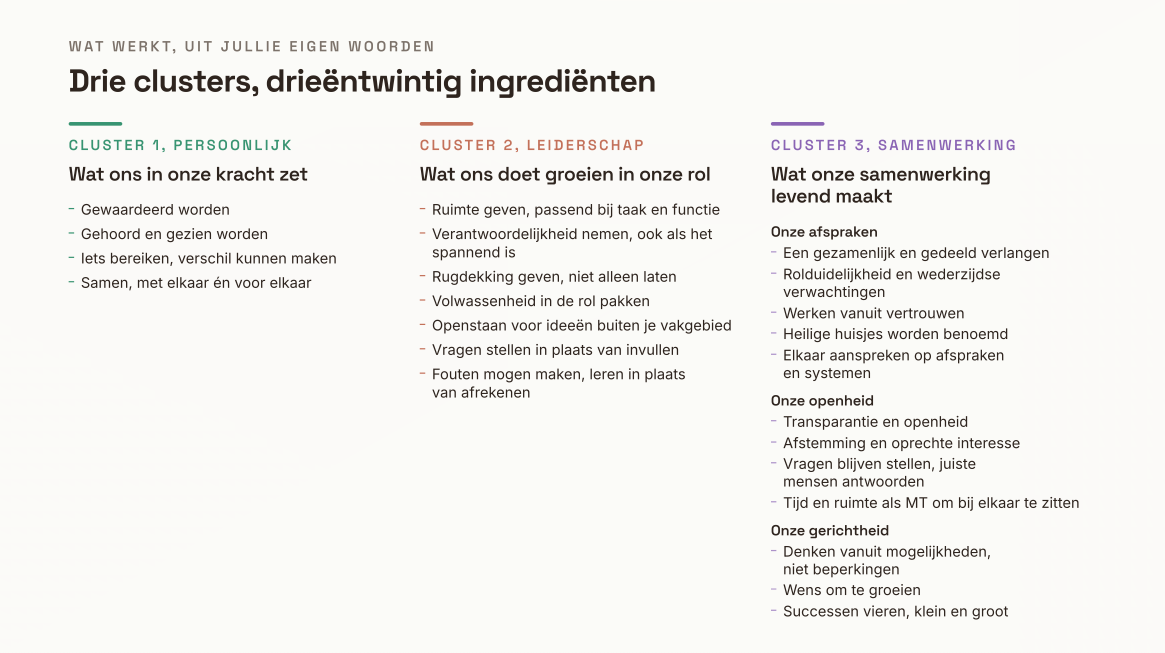 Image: Working ingredients — cross-section in three columns, made on demand by AI during the two-day session
Three columns where working principles from day one and day two come together. Made on demand during the session. Click for larger.
And underneath all those moments sits something harder to name: that it was recognizable as their own work. The difference between something written about a group, and something fished out of a group. Lars sums it up in the conversation with a bicycle metaphor: it didn't become a Ferrari, it did become a Solex, a little electric motor under the same bike. That's exactly the calibration of what AI added here. During the two-day session itself the test had already succeeded; Lars says it landed and that participants were impressed. The master document Joost sent yesterday to the co-organizer is, at the time of this conversation, still unanswered. Whether it then gets picked up further is still in motion.
What the AI added in this two-day session
The added value isn't in the separate functions, but in how they stack: from own summary to own annual plan, with their own words as the throughline. And sometimes "good enough" is good enough for exactly that reason.
"I'm almost becoming a kind of sales broker."
Lars facilitates in the room, Joost sits at a distance. The two-day session is running. Joost listens in now and then through a headset. "Voyeuristic?", Lars asks out loud, like a fly on the wall. Joost: a bit ethically slanted, yes. A scaled-up version would be a live help desk. But at the same time something sinks in that he hadn't expected. If Dembrane just works, and if the facilitator is handy with the verify function, then he actually has little to do. "It's good enough, apparently."
That's a strange compliment to give yourself. Because it also means that the role he's playing now (technical backup, AI prime-mover, broker between the work and the model) drops away the moment it works. And that's precisely what Joost doesn't quite want to be. He feels himself becoming a sales broker between the work in the room and the AI at a distance. Not the craft he really wants to be good at.
What he does want, he puts into words more clearly today than before. His training was industrial design: the translation from what technology makes possible into valuable applications. That translation, but then for social design. Industrial design for social design. Not building the tool, not facilitating the session, but designing the translation layer that connects the social and the technological in a thoughtful way. That's where Dembrane appeals to him: not as a user, but as a designer of what's possible on it, beside it, and around it.
What does the human do when the technology works?
Three roles that now often sit in one person, with Joost usually all three at once, and so stay invisible. Separating them makes visible what the work actually is. What Joost puts into words today: ideally split them, with himself mostly on the third, the designer.
Underneath that role question sits something more personal. In his free time Joost is poring over transcripts of the steering group meetings in Doesburg. He finds things in them he considers valuable, laying lenses, running variants, looking for overlap to test where the AI output is reliable. But nobody asks for it. The work happens alone, and that design part is, in his own words, damn lonely. "At the plumber's house the tap leaks." The pattern Joost has been running into for years: being the owner of something is what he helps others become, but for his own work it comes less easily to him. Designing remains, he says, a lonely place.
"That's where it happens. What is it? The magic."
The moment Lars asks where Joost gets his joy from, the answer comes instantly. "I get the most joy from co-exploration." Not from facilitating, not from building himself, not from writing documents alone. From sparring together with someone who says: "wait, try this, look what I found." That's what's missing in Doesburg and what he does experience with Lars today.
A pause on that. Co-exploration isn't a method choice for Joost, it's what makes his work livable. Only then does the conversation turn outward.
Lars sums it up in a sentence that, for him, spans the whole field. Meeting of the Minds, that's where it happens. The moment that encounter falls apart and everyone retreats into their own expertise, it gets interesting on the detail but the magic is gone. That holds for two people at a table, and it holds for the kind of event they've started to think they want to organize.
The dream that slowly takes shape in the conversation: a day where people who make this technology, people who use it in group processes, and people who have experienced it as participants get into conversation with each other in the same room. Not lecturing. Not pitching. Co-exploring. Three channels of experience at one table, and seeing what comes out when they actually meet. In that light, the next two coffee moments in the Expedition are a prequel. A finger exercise for what a larger gathering could be.
Who meets whom when the magic gets to happen?
Three channels of experience that rarely sit in the same room. Makers mostly work only with other makers. Facilitators learn from other facilitators. Participants disappear after the session. The event they're thinking of brings those three together, with the simple question: what did you actually experience?
Just before twelve they get up. Joost has to catch his train, so Lars checks out first: enjoyment, co-exploration, a sense of more togetherness ahead. Then Joost: the coupling of ideas with lived experience, a connection of worlds between the social and the technological, and a slight frustration about the exploration of the working method itself. But with that, also gratitude for the time and the attention. Two check-outs, honest and different in tone, both born from this same hour.
Was this helpful?