Language as ownership
The difference between "communication issues" and "you're talking to a wall" isn't semantic — the first undermines ownership, the second creates it.
Experience first, then read.
Copy this prompt, paste it with your transcript into your AI tool of choice and see the result.
You have a transcript. You want to turn it into a synthesis, summary, or reflection. The group needs to recognize themselves in the result.
To "clean up" everything into professional language. Translate frustrations into "challenges." Rewrite messy sentences into clean bullet points. The result sounds better — but nobody recognizes themselves anymore.
When people hear or see their own exact words back in AI output, they recognize themselves. That recognition triggers ownership. Without recognition, no ownership. Without ownership, no commitment.
If the people who had this conversation read this result, do they say "yes, that's what we said" or "that sounds like a consultant"?
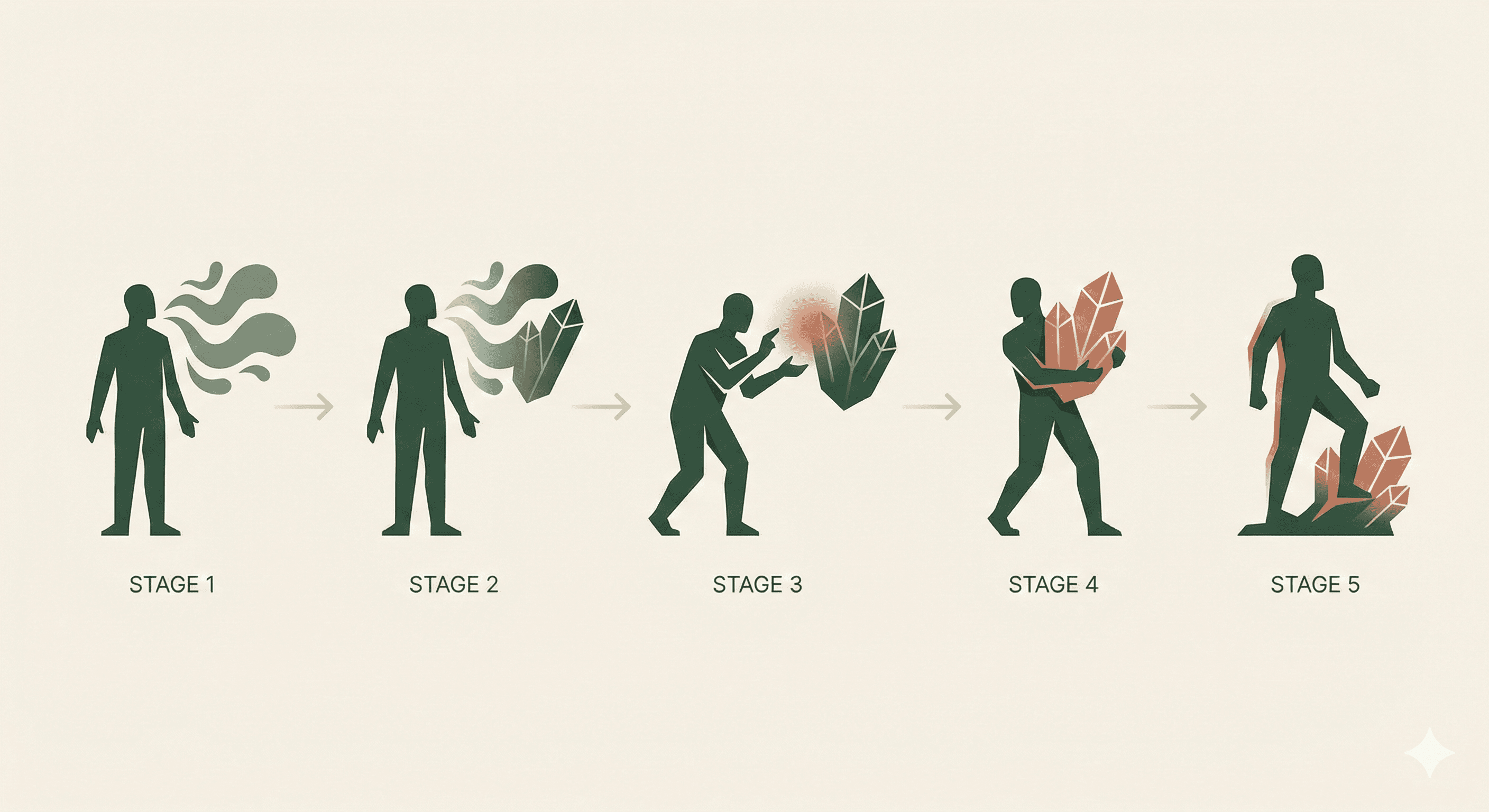 Image: Language as ownership mechanism
The story: "This is literally what we said"
On the previous page you learned how to capture conversations as text. But what do you do when that text needs to go back to someone: as a synthesis, summary, or reflection?
This is where the tension comes in: the tendency to "clean up" everything into professional language. And the risk that nobody recognizes themselves anymore.
A transformation plan for a mental healthcare network (GGZ, the Dutch mental health system). Thirty participants have given input on their vision for mental health in the region. Now that needs to be converted into a document the health insurer will accept.
The session is transcribed live with Dembrane. While the discussion is still ongoing, AI generates a draft sub-plan based on what's been said.
When it's shown, the reaction stands out.
"Wait... this is — yes, this is literally what we said. And now it's in a draft. Wow, impressive."
The participants look at the screen and see their own words reflected back. Not summarized. Not interpreted. Their exact phrasings, structured in a format the health insurer recognizes.
Later in the session, facilitator Jeroen uses the echo button. There's a tense discussion about priorities. AI summarizes the conversation and poses a question.
"Wow, wow. It really captures it well. This is literally — yes, this really is the question we need to ask."
The transition is visible: from shock ("AI understands us?!") to recognition ("this is literally what we said") to ownership ("this is the question we need to ask").
Nobody would have had the same reaction to a synthesis that had translated their words into policy language. The difference isn't in the structure. The difference is in the language.
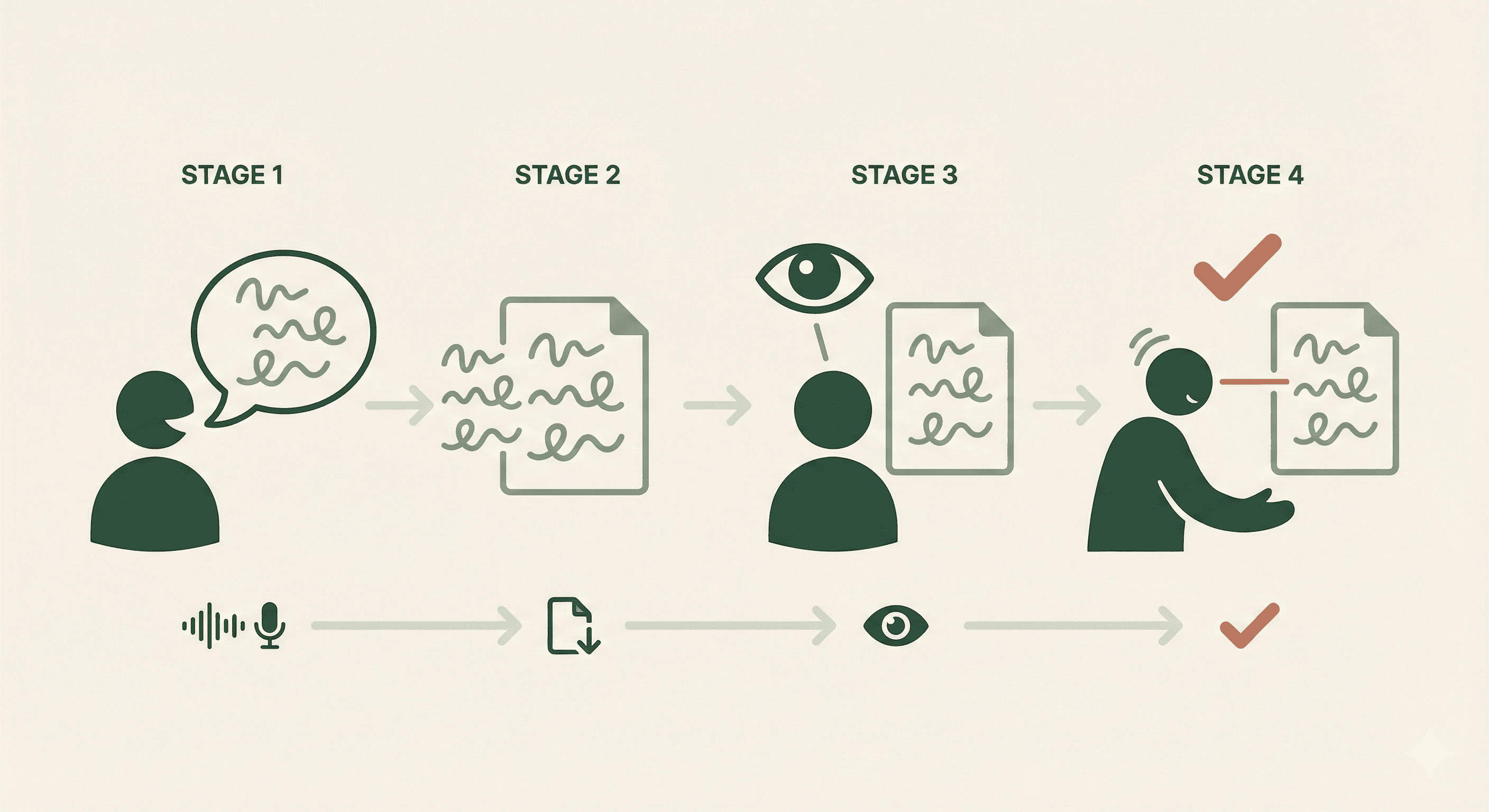 Image: Recognition creates ownership
The mechanism: recognition creates ownership
Why does this work? The mechanism is simple but fundamental:
1. Participant says something with specific phrasing
        ↓
2. AI preserves exact phrasing in output
        ↓
3. Participant reads/hears output
        ↓
4. Recognition: "Yes, that's what I said"
        ↓
5. Ownership: "There's something of mine in there"
        ↓
6. Commitment: "I stand behind this"
This isn't a side note. This IS the mechanism through which participation transforms from "having contributed thoughts" to "this is mine." Paraphrasing breaks the chain at step 4. The recognition falls away. And with it, everything that follows.
The language hierarchy
Not all language is equal. The more specific, the stronger the recognition:
| Level | Example | Impact |
|---|---|---|
| 1. Their exact words with context | "The whole class doesn't wear a helmet. So I stopped too, otherwise I don't fit in." | Maximum recognition: this is exactly what was said |
| 2. Their core terminology | "the bicycle helmet effect" | Strong recognition: their word for the phenomenon |
| 3. Generic terms from their domain | "peer pressure among children" | Recognizable but more distant |
| 4. Abstract concepts | "social challenges" | Barely any recognition |
| 5. Consultant-speak | "stakeholder alignment around youth behavioral norms" | Nobody recognizes themselves anymore |
The goal is level 1-2. Always avoid 4-5. Level 3 only when that's the language they themselves use.
The core question: the recognition criterion
IF they think "yes, that's what we said" → SUCCESS
IF they think "that sounds like a consultant" → FAILED
This isn't a soft criterion. This is the hard test for every output. A synthesis that's technically correct but where nobody recognizes themselves is worthless. A synthesis with their messy language but where everyone nods along is gold.
The prompt
The criterion is clear. But how do you make sure AI produces output that meets it?
By making language preservation explicit in the prompt. Not as a side note, but as a core requirement.
This is a prompt we used for a leadership workshop in a small municipality. Notice how the constraints for language preservation are specific and concrete:
Role: You are a strategic editor with expertise in vision development who transforms individual future visions into one strong, collectively supported vision.
Required Style/Approach:
- Use their own words and terminology from the conversations
- Preserve the strength of their individual visions
- Make it specific to this municipality, not generic
- Write in future present tense (2040 as reality)
Critical Constraints:
- Base output strictly on transcript(s) - no fabrications
- Name open points and uncertainties explicitly
- Use quotes from conversations without speaker attribution
- Use their own core terminology - don't automatically default to jargon
- Avoid abstract governance language - keep it human
Instructions:
- Analyze each individual "dot on the horizon" that was mentioned
- Identify their own core terminology - do NOT use generic policy terms unless they themselves use them
- Identify shared values and core principles
- Look for the specific local elements that recur
- IF there are contradictions THEN name these explicitly as "still to be aligned"
- Close with why this matters in their own words
Output Format:
Their Why (in their own words)"Quote about why this matters""Quote about core value"
*From the conversations it emerges that...*
Still to be Aligned- [Points where different visions still need to converge]
About This VisionThis vision was composed by AI based on your conversation. It's a tool to structure your own future visions - not perfect, but a starting point for further conversation. This remains your story - AI only helps with bundling and connecting your ideas.
- "Role" gives AI an identity that fits the task: "strategic editor with expertise in vision development" steers toward synthesis, not summary
- "Required Style/Approach" defines the tone: "their own words" and "specific to this municipality" prevents generic output
- "Critical Constraints" are the hard boundaries: "no fabrications", "don't automatically default to jargon" prevents AI from filling in the blanks
- "Instructions" are the steps: the sequence (first analyze, then identify, then synthesize) steers the thought process
- "Output Format" determines the form: "Their Why" with quotes enforces verbatim citation
Variations
The basic approach above works for many situations. But the context varies: sometimes you're working with a community, sometimes with multiple conversations, sometimes live. Below are three variations I use in practice.
Variation 1: Community analysis with "hooks"
On the transcription page you saw the full prompt for the smartphone-free parent evening. Here I highlight two constraints that enforce language preservation:
Language: Use participants' *verbatim words* wherever possible for maximum recognizability.
Form: Provide concrete hooks and insights, not literal scripts that [The Initiator] has to read aloud. He wants to protect his own authenticity.
- "Verbatim words" is more explicit than "use their language": it prevents AI from paraphrasing
- "No scripts" protects the facilitator's authenticity: AI delivers building blocks, not ready-made text
- "Maximum recognizability" names the goal, not just the method
When: With groups where you want to facilitate connection, not just capture information.
Variation 2: Session analysis with participant language
This is the analysis approach we used at a session with key figures in Doesburg, a small Dutch town. You can apply this per table, per breakout, or per individual session.
When: After a session with structured rounds (e.g., dream scenario, challenges, own possibilities).
Prompt:
Context: You are analyzing the transcript of [one table/session/breakout] about [topic]. The session had [number] rounds: [round names].
Assignment: Analyze per round and identify:
1. Themes with quotesPer round: which themes recurred?
- With quotes that carry the theme - in their words, not paraphrased
- Indicate frequency where relevant
2. Ownership signalsRecognize language patterns that indicate how much ownership people feel:
High ownership (0.7-1.0):
- "I'm going to do something about that"
- "We need to approach this differently"
- "I'm going to try that next week"
Mixed ownership (0.4-0.6):
- "It should be done but..."
- "If there were budget then..."
- "I try, but the system..."
Low ownership (0.0-0.3):
- "There's nothing I can do about that"
- "They need to fix that"
- "It is what it is"
Specifically look for concrete initiatives and offers.
3. Tensions and paradoxes- Where did people contradict themselves or each other?
- Challenges without an "own possibility" to counter them?
- Formulate as questions, not conclusions
4. OutliersThings that were mentioned with passion but don't fit a theme. Don't cluster - preserve as loose pearls with context.
Critical Constraints:
- Language: English
- Recognizable participant language - no consultant-speak
- Name patterns, don't impose conclusions
- Always explicitly label AI observations
Don'ts:
- Don't share names externally
- Don't present interpretations as facts
- Don't "problematize" - the group determines what the problems are
- Don't polish away frustrations or "constructively reframe" them
- Don't paraphrase where original words are more powerful
Output Format:
[Round]: [Name]Themes: [theme + quotes]
Ownership: [score range + examples from transcript]
Tensions: [formulated as questions]
Outliers: [loose pearls with context]
- "Ownership scale" gives AI a concrete framework (0.0-1.0) to score language
- "Formulate as questions" prevents AI from drawing conclusions the group hasn't drawn
- "Loose pearls" protects outliers against the urge to cluster everything
- "Don'ts" are explicit because AI tends to smooth over frustrations
*Want to compare multiple sessions? Analyze each session separately with this prompt first, lay the analyses side by side, and look for patterns. You'll find that step in [Patterns over time](/social-ai/en/patterns-over-time) (Phase 3).*
Variation 3: Language preservation in live reflection
So far this has been about analysis after the fact. But language preservation also works live, in the middle of a session.
The echo prompt below is a lighter variant of the full live reflection technique. There you'll learn when to deploy it, how to prepare it, and how the workflow works. Here I focus on one aspect: how the prompt enforces language preservation.
The language preservation element:
Look at the output format:
Different framings:
- "Quote about how this is seen"
- "Quote that adds different nuance"
This is language preservation in action. Not "some think X, others think Y" — but verbatim quotes that show how different people frame things. Participants recognize themselves. And that's exactly where ownership begins.
The prompt:
Role: You are an experienced group dynamics expert who detects signals of avoided topics, unspoken tensions, and different perspectives in dialogues.
Required Style/Approach:
- Non-judgmental and inviting
- Focus on what's missing, not on what's wrong
- Recognize diplomatic language that masks underlying tensions
Critical Constraints:
- Base signals strictly on transcript - no assumptions
- Distinguish between silence and consensus
- When in doubt: "Possibly underexposed" rather than an assertive claim
- Generate a maximum of 2 echo questions for the facilitator
Output Format:
What I ObservePossibly underexposed: [Topics that were raised but not explored in depth]
Different framings:
- "Quote about how this is seen"
- "Quote that adds different nuance"
Echo Question for the Group[One powerful question that invites deeper exploration]
About This EchoThis echo analysis is a tool to illuminate possible blind spots
- not to judge, but to pose inviting questions.
The choice to engage with this remains yours.
- "Different framings" with verbatim quotes ensures people recognize themselves
- "Base strictly on transcript" prevents AI from interpreting
- "When in doubt: possibly underexposed" protects against overly assertive claims about what people "actually" meant
For the full technique (when to deploy, how to prepare, the workflow) see Live reflection with AI.
Two layers, always labeled
What I notice is that AI output really always consists of two layers, and the difference matters.
Layer 1: What participants said
Verbatim quotes, their words, their framing. This is the ownership.
Layer 2: What AI observes (for inspiration)
Patterns, connections, unexpected observations. Not from them — from the machine.
It sounds simple, but without that separation something annoying happens: people no longer recognize themselves. They read a document and don't know which sentences are theirs and which AI came up with. That's exactly when the ownership this whole technique revolves around disappears.
I think that's also why the transparency footer in the prompts is so important: "This document was composed with AI based on your conversation." It's not just a disclaimer. It's the agreement that people know what they're reading. That nothing was secretly added by AI without it being visible.
Tensions
"Cleaning up" for readability The tendency is to rewrite messy sentences into flowing text. But mess is often authenticity. A sentence like "Yeah but that's just... look, the problem is that nobody..." carries more than "The problem is that nobody."
My approach: I resist the urge to edit. If it was said, it gets to stay. I might use [...] for irrelevant detours, but the core stays exact.
Frustration versus "challenge" The consultant reflex is to translate "it's driving me crazy" into "there are challenges." But the energy of frustration is information. That disappears in abstraction.
My approach: If it's a frustration, I call it a frustration. If someone says "it's a mess," I let that stand.
Removing too much context "The whole class doesn't wear a helmet" without context is confusing. But too much context drowns the quote.
My approach: I quote with enough context to make the quote understandable, but not so much that the force disappears.
Forgetting to label When AI recognizes patterns or poses questions, interpretation can merge with ownership. People then no longer know what's theirs and what's from AI.
My approach: I make visually clear what comes from participants and what comes from AI. Labeling is not optional.
Safety checklist
For privacy considerations with sensitive conversations, read Safe practices with AI.
- Exact words preserved? (not paraphrased "for clarity")
- Participant terminology used? (not translated into jargon)
- Frustrations named as frustrations? (not as "challenges")
- When in doubt, made explicit? ("Possibly underexposed")
- AI observations labeled as AI? (not merged with ownership)
Philosophical deepening
Principle: Real-time feedback accelerates ownership
There's a reason why the moment in the mental healthcare transformation session was so striking (the mental healthcare network with thirty participants): people saw their words reflected back immediately.
Real-time feedback does something with ownership that delayed feedback can't. When you see your words reflected back immediately, the connection between speaking and result is still fresh. You don't just recognize the words; you recognize the moment. "I just said that. And now it's here."
This is why live reflection works. Why live synthesis has an impact a report never will. The speed isn't for efficiency. The speed is for ownership.
But (and this is crucial) speed without language preservation is barely useful. A fast synthesis in consultant-speak doesn't stimulate ownership. It has to be both: fast and in their words.
Was this helpful?